


Saint Nicholas of Myra Medal Necklace - Bishop, Protector, Patron of Children
Saint Nicholas of Myra Medal Necklace - Bishop, Protector, Patron of Children
He Threw Gold Through a Window in the Dark - and Never Waited to Be Thanked. Long before Santa Claus, Nicholas was a bishop who gave away his entire inheritance in secret, one family at a time. This medal is for the child who needs a protector, and for anyone who believes real generosity asks for nothing back.
Couldn't load pickup availability
Made in the USA
Made in the USA
Every Sanctum Medals piece is made to order in the United States. Your medal is not sitting in a warehouse. It is produced individually after you place your order, which is why it arrives with a quality and finish that mass-produced religious jewelry doesn't match.
Arrives in an Elegant Jewelry Box
Arrives in an Elegant Jewelry Box
Every order ships in an elegant jewelry box at no extra cost. Whether it's a gift or something you're keeping for yourself, it arrives the way it deserves to.
Shipping
Shipping
Production takes 5 to 6 business days before shipping. If you are ordering for a specific date - a confirmation, a feast day, a birthday - place your order at least two weeks in advance to allow for production and delivery.
Secure Checkout
Secure Checkout
Checkout is encrypted and handled by a certified payment processor. We accept all major credit cards, PayPal, Shop Pay, Apple Pay, and Google Pay. Your payment details are never stored.
Specifications
Specifications
- Available in stainless steel or 18k gold finish
- Black ink on metal surface sealed under shatterproof liquid glass coating
- Pendant: 0.9" x 0.9" (23.5mm x 23.5mm)
- Adjustable snake chain: 18" to 22" (45 to 56cm)
- Optional engraving on reverse: 2 lines, 20 characters per line, Tangerine cursive font
Share


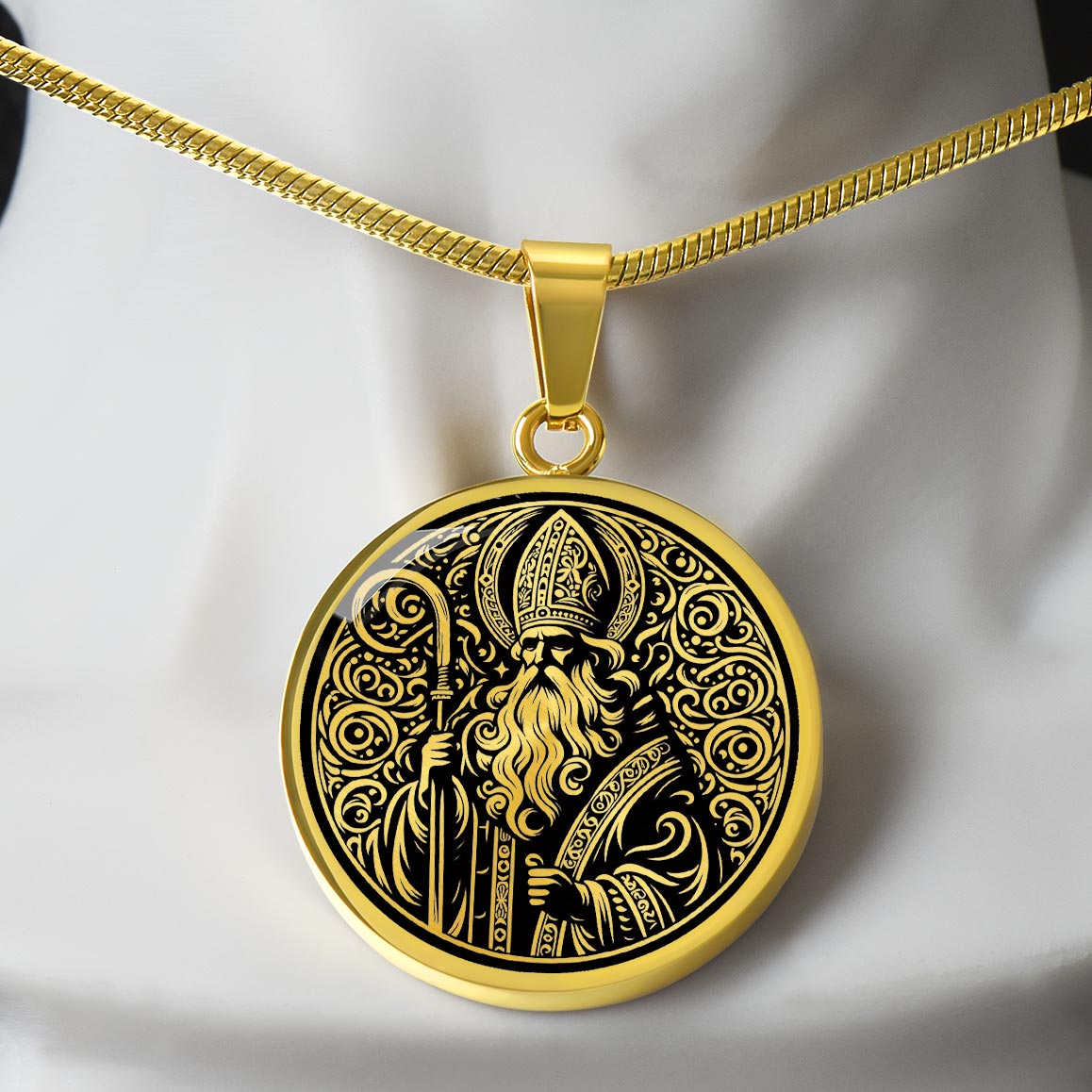
Saint Nicholas of Myra, Patron Saint of Children
Nicholas was born in the third century in what is now southern Turkey, to wealthy Christian parents who died when he was young. He used his entire inheritance to help the poor and families in crisis, was appointed Bishop of Myra as a young man, imprisoned under Diocletian's persecution, and later attended the Council of Nicaea in 325, the council that produced the Nicene Creed. The story behind every Christmas tradition traces back to one act, when he heard that a man in his diocese had three daughters and no money for their dowries, facing destitution. On three separate nights, Nicholas threw a bag of gold through the family's window, anonymously, in the dark, without being seen or thanked. That single act of secret, practical generosity became the origin of the stockings by the fireplace and the gifts left in shoes every December 6. He died in Myra in 343, and his relics remain in Bari, Italy, still drawing pilgrims from across the Catholic and Orthodox world.
A Gift For...
- A child, for protection and for the wonder of his real story
- A sailor, or anyone who works at sea
- Someone who has been wrongly accused or treated unjustly
- A baptism gift for a child named Nicholas
- A December 6 gift, celebrated as Nicholas Day across much of Europe
- Anyone who needs "Give in secret. God sees it all" close by
A Confirmation Gift for Nicholas
For a boy who wants a patron known for generosity rather than suffering, Nicholas is the obvious answer. Engrave a name and confirmation date on the back.
The Saint Nicholas of Myra Medal
This medal depicts Nicholas full face in full episcopal vestments, the mitre on his head, the cope across his shoulders, the pallium marking his authority as bishop, a crozier in one hand and his other raised in blessing. Dense baroque scrollwork fills the field around him, the most ornate and formally episcopal composition in the catalog. He is shown as what he was, a bishop, not a gift giver or a seasonal figure. The natural gold or silver of the metal forms the illustration itself. Black ink is applied to the pendant surface and the metal shows through as the image. A shatterproof liquid glass coating seals the surface.
Personalization and Engraving
The optional engraving on the reverse is rendered in Tangerine cursive. Two lines, up to 20 characters each. Two lines that fit: "Give in secret." and "God sees it all." For a name day gift on December 6, most people engrave a name and the year.
Saint Nicholas of Myra's feast day is December 6. He gave away his inheritance, attended the council that defined the Creed, and became the patron of more human situations than any other saint the Church has ever named.
Unlike stamped or printed medals, our black ink artwork is applied directly onto the surface, so every bright line in the illustration is the metal itself shining through, with detail no stamped medal can hold.
Sealed with a durable, crystal-clear liquid glass coating to protect the vibrant image for a lifetime.
Custom-illustrated in-house, ensuring every saint's depiction is completely unique to our store.
Carefully assembled, sealed, and custom-engraved to order right here in the United States.
FAQ
How long does production take?
Each medal is made to order in the USA. Production takes 5-6 business days before shipping. If you need it for a birthday, confirmation, or any specific occasion, order at least two weeks in advance to be safe.
What does the engraving look like?
The reverse is engraved in Tangerine cursive — an elegant, flowing script. You get two lines, up to 20 characters each. Names, dates, short quotes. The engraving is laser-etched directly into the metal, not printed.
Is the chain included?
Yes. Every medal ships on an 18-22" adjustable snake chain in the same finish as the medal - stainless steel or 18k gold. No need to source a chain separately.
Are the medals hypoallergenic?
Yes. Both options are made from medical-grade 316 stainless steel. The 18k gold finish is applied over that same 316 stainless steel base. Safe for sensitive skin.
How durable is the coating?
Each medal is hand-sealed with a shatterproof liquid glass coating poured directly over the surface. It protects the artwork from scratches and moisture without dulling the detail or altering the color. It's designed to be worn daily, not kept in a drawer.
What's your return policy on engraved orders?
Because every medal is custom-made to order, engraved pieces cannot be returned unless there's a defect or error on our part. If anything arrives damaged or incorrect, contact us and we'll make it right.