


Saint Margaret of Scotland Medal Necklace - Queen, Reformer, Patron of Scotland
Saint Margaret of Scotland Medal Necklace - Queen, Reformer, Patron of Scotland
She Wanted to Be a Nun. She Became a Queen Instead - and Reformed a Nation. Margaret ruled Scotland, raised eight children, and rebuilt a church that had drifted from Rome, all while living a private life of prayer few queens ever attempted. This medal is for the woman carrying more than anyone sees, and for anyone who has been wrongly accused and needs a patron who understands what real authority is for. Made to order in the USA.
Couldn't load pickup availability
Made in the USA
Made in the USA
Every Sanctum Medals piece is made to order in the United States. Your medal is not sitting in a warehouse. It is produced individually after you place your order, which is why it arrives with a quality and finish that mass-produced religious jewelry doesn't match.
Arrives in an Elegant Jewelry Box
Arrives in an Elegant Jewelry Box
Every order ships in an elegant jewelry box at no extra cost. Whether it's a gift or something you're keeping for yourself, it arrives the way it deserves to.
Shipping
Shipping
Production takes 5 to 6 business days before shipping. If you are ordering for a specific date - a confirmation, a feast day, a birthday - place your order at least two weeks in advance to allow for production and delivery.
Secure Checkout
Secure Checkout
Checkout is encrypted and handled by a certified payment processor. We accept all major credit cards, PayPal, Shop Pay, Apple Pay, and Google Pay. Your payment details are never stored.
Specifications
Specifications
- Available in stainless steel or 18k gold finish
- Black ink on metal surface sealed under shatterproof liquid glass coating
- Pendant: 0.9" x 0.9" (23.5mm x 23.5mm)
- Adjustable snake chain: 18" to 22" (45 to 56cm)
- Optional engraving on reverse: 2 lines, 20 characters per line, Tangerine cursive font
Share


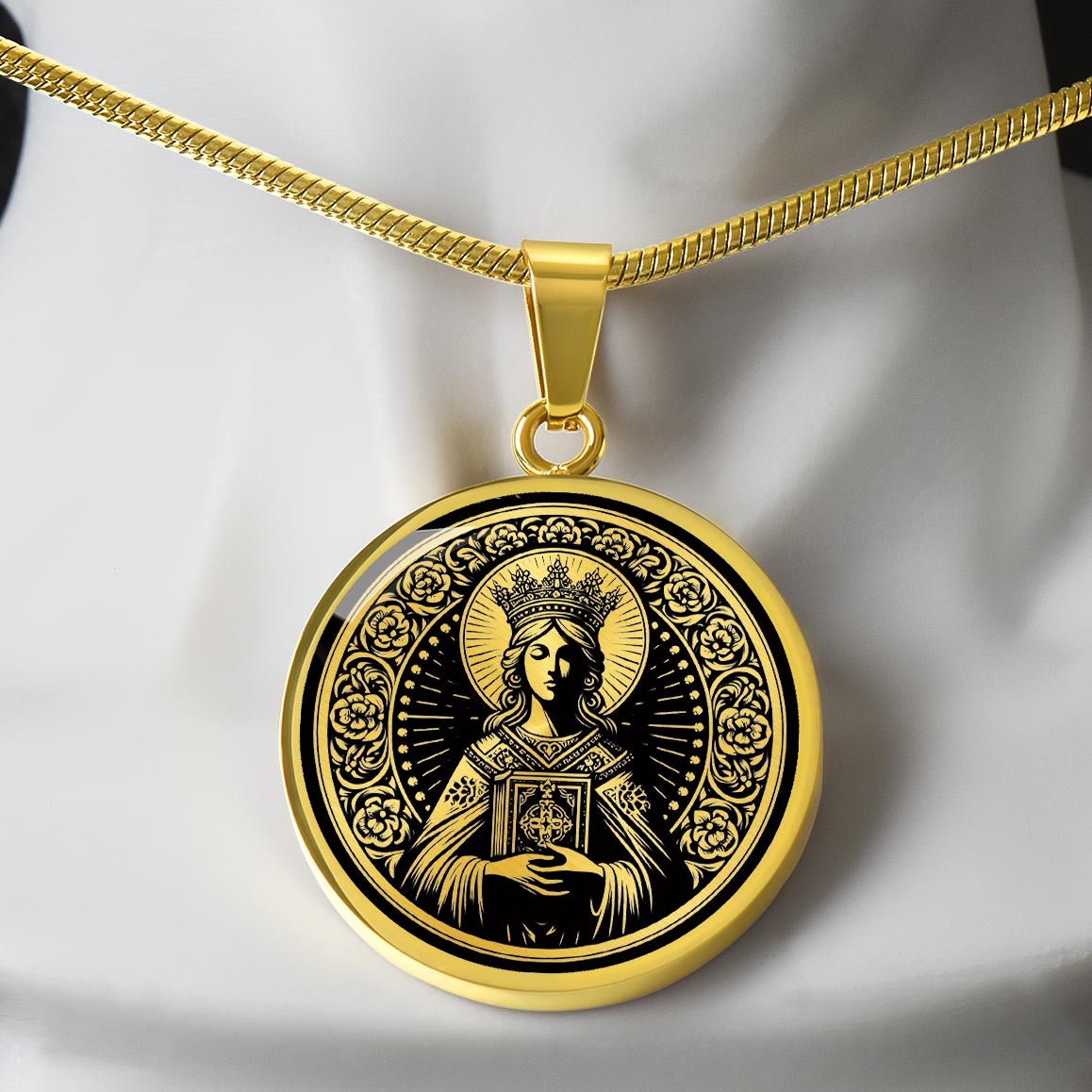
Saint Margaret of Scotland, Patron Saint of Scotland
Margaret was born around 1045, granddaughter of an English king, and fled north with her family when William the Conqueror invaded in 1066, landing at the Scottish court of King Malcolm III. Malcolm wanted to marry her. Margaret wanted to be a nun. She married him anyway, then reformed the Scottish Church, which had drifted from Rome, convening councils and arguing her case directly in front of bishops while her husband, who spoke no Latin, watched in admiring silence. She founded an abbey, funded pilgrim ferry crossings, ransomed English slaves held in Scotland with her own money, and rose before dawn to pray and wash the feet of the poor. She governed Scotland, raised eight children, several of whom became rulers themselves, and maintained a private discipline of prayer her biographer called monastic. She died in 1093, four days after learning of her husband's death in battle.
A Gift For...
- A woman carrying the weight of a household, a family, or an institution
- A woman in a position of leadership or authority
- A large family, one of her lesser known patronages
- Someone who has been wrongly accused and needs a patron who understands justice
- A confirmation or name day gift for a woman named Margaret
- Anyone who needs "She ruled well and loved more" close by
A Confirmation Gift for Margaret
Margaret suits a confirmation candidate whose life is going to be full, not a single virtue on a pedestal but a whole life lived seriously. Name and date, engraved on the reverse.
The Saint Margaret of Scotland Medal
This medal depicts Margaret from the waist up, crowned, in ornate royal vestments, holding a jeweled book of the Gospels against her body with both hands. The composition is the most formally regal of any female saint in the catalog. She is shown as she actually was, crowned, robed, holding Scripture, facing forward, not in prayer or contemplation. The natural gold or silver of the metal forms the illustration itself. Black ink is applied to the pendant surface and the metal shows through as the image. A shatterproof liquid glass coating seals the surface.
Personalization and Engraving
The optional engraving on the reverse is rendered in Tangerine cursive. Two lines, up to 20 characters each. Two lines that fit: "She ruled well" and "and loved more." For a gift to a woman in a position of leadership or responsibility, most people engrave a name and the year she took on that role.
Saint Margaret of Scotland's feast day is November 16. She was offered a crown when she wanted a cloister, accepted it, and did more with it than almost anyone who sought it.
Unlike stamped or printed medals, our black ink artwork is applied directly onto the surface, so every bright line in the illustration is the metal itself shining through, with detail no stamped medal can hold.
Sealed with a durable, crystal-clear liquid glass coating to protect the vibrant image for a lifetime.
Custom-illustrated in-house, ensuring every saint's depiction is completely unique to our store.
Carefully assembled, sealed, and custom-engraved to order right here in the United States.
FAQ
How long does production take?
Each medal is made to order in the USA. Production takes 5-6 business days before shipping. If you need it for a birthday, confirmation, or any specific occasion, order at least two weeks in advance to be safe.
What does the engraving look like?
The reverse is engraved in Tangerine cursive — an elegant, flowing script. You get two lines, up to 20 characters each. Names, dates, short quotes. The engraving is laser-etched directly into the metal, not printed.
Is the chain included?
Yes. Every medal ships on an 18-22" adjustable snake chain in the same finish as the medal - stainless steel or 18k gold. No need to source a chain separately.
Are the medals hypoallergenic?
Yes. Both options are made from medical-grade 316 stainless steel. The 18k gold finish is applied over that same 316 stainless steel base. Safe for sensitive skin.
How durable is the coating?
Each medal is hand-sealed with a shatterproof liquid glass coating poured directly over the surface. It protects the artwork from scratches and moisture without dulling the detail or altering the color. It's designed to be worn daily, not kept in a drawer.
What's your return policy on engraved orders?
Because every medal is custom-made to order, engraved pieces cannot be returned unless there's a defect or error on our part. If anything arrives damaged or incorrect, contact us and we'll make it right.